Not Set
The mine-watching vessel FS Poulmic was blown up by an acoustic mine on the first day it was under the command of its new French captain.
Type
Patrol ship
History
On Friday, 19th June 1940, Allied forces were evacuated from ports in Western France to escape the invading German army as part of Operation Aerial. The huge French battleship Paris arrived in Plymouth on that day along with the Fleet destroyer Le Triomphant and submarine Surcouf. Along with the larger ships came the transport ship Poulmic.

Drawing of the Poulmic by The SHIPS Project, click the image for a larger version
Poulmic was inspected and found to be clean and in good seagoing condition, with twin diesel engines in good order. She was a welcome addition because most of the other French ships were found to be dirty and in very poor condition. Poulmic and her sister ship Lanvéoc were built in 1937 to be used as transports for moving personnel and aeronautical equipment between Brest dockyard and the Naval Air Station at Poulmic-Lanveoc. The 37m long vessels were built at the Forges & Chantiers de la Mediterranee (FCM) shipyard in Graville (Le Havre). Poulmic was soon put into service as a transport between ships in Plymouth harbour, operating under British command, but later she was equipped for mine watching duties. She was handed over to the newly formed Free French Navy (FNFL) under the command of Premier Maître de Manoeuvre Le Guen, and became FS Poulmic.
On 7th November 1940, Le Guen was not available to command his ship, and Officier des Equipages Paul Vibert volunteered for that duty. Vibert had escaped France for England in June 1940 and was one of the few French officers who chose to join the Free French Navy in England. Vibert joined the Poulmic that morning, meeting her second in command, Premier Maitre Redon and British naval officer Sub. Lt. Marston, RNVR, who was there to train Vibert in mine-watching duties. At this time, British naval ports like Plymouth were subject to nightly raids by German bombers, which would drop parachute mines in the harbour in the hope of sinking a passing ship. Poulmic and other smaller ships were used for mine watching. The crew on board would track the fall of an enemy mine dropped from an aircraft in an attempt to locate its position so it could be avoided, then later rendered safe.
The ship received orders to set sail and take up position for the night at a point approximately three miles south of the Plymouth breakwater. As Poulmic proceeded out of the harbour, night was falling, and the sea was calm. Vibert was outside on the bridge wing, Marston and the helmsman were on the bridge along with the engine telegraph operators, and three crew were on the bow ready to drop the anchor. Redon checked their position with a compass, ordered the vessel to a stop, then ordered engines astern at half speed. Suddenly, there was a terrible explosion, the little ship had triggered an acoustic mine dropped on the seabed precisely at their allotted mine watching position.
The explosion occurred directly underneath the ship, creating a huge spray of water. It tore the Poulmic in half, destroying the engine room. Vibert was blown upwards into the air before landing headfirst on the deck, where he lost consciousness. Redon was thrown backwards against the helm and fell over. He quickly got up and saw the helmsman, Marsdon and the telegraph operator lying on the bridge deck. The vessel was listing to starboard and sinking, but he had just enough time to grab one of the lifejackets from under the chart table before jumping into the water. The ship went down in an upright position in 14m of water with only the mast remaining visible on the surface.
At the time of the explosion, the Royal Navy destroyer HMS Jersey was entering harbour astern of HMS Kashmir. Jersey immediately stopped and sent away her whaler to pick up survivors, then they both illuminated the scene of the accident with their bright searchlights, as did a torpedo boat about two miles away. The French minesweeper Plougastel was moored nearby; she weighed anchor immediately and was the first on the scene to pick up the survivors. Practically the whole ship’s company were drawn down with the ship, but two crew who were on deck managed to escape along with Vibert, Redon and six others. Vibert was seriously wounded in the head and legs from the initial explosion, but he managed to keep afloat until he was picked up by the rescue boat. Eight of the Poulmic’s crew died in the explosion along with the British RNVR officer, Hugh Charles Marston.
An enquiry into the loss of the Poulmic was held at the R.N. Barracks in Devonport in December. They found that the loss was due to an acoustic mine moored by German aircraft during their nightly raids on Plymouth. Sub Lt. Donald A. Pennison, R.N.V.R, the ex-skipper of Poulmic, told the court that she had noisy diesel engines which probably set off the mine. As a consequence of the loss, diesel-driven craft were no longer employed in mine watching duties outside the Sound.
Paul Laurent Vibert recovered from his injuries and was promoted before returning to Minerve in February 1941 after discharge from hospital. Vibert continued to serve in the French Navy until 1963 and died on 20 May 1970. Vibert was awarded the Officier de la Légion d'Honneur and the Ordre de la Libération. Poulmic herself was honoured, she was the first FNFL vessel to be sunk, and she was given the Medal of the Resistance by General de Gaulle.
This is a condensed version of the story. For more information, please contact The SHIPS Project.
Diving the Poulmic

Site plan of the Poulmic wreck by The SHIPS Project, click the image for a larger version
The vessel sustained heavy damage and is now scattered across the seabed between reef outcrops a few metres high running approximately north/south. Most of the debris is low lying and covered with seaweed during the summer months making it difficult to distinguish wreck debris from the underlying seabed. Small bits of broken pottery are scattered across the site. Machinery, such as the engine and deck winches, and ship’s structure remain on the seabed to be explored.
So far the bows of three vessels have been found in the area by the SHIPS Project team suggesting that the remains on the seabed are actually from three different ships. Work is now being done on the site by the Project team to identify the different sections of each vessel. Artillery shells surrounded the site in years past but many have been removed from the seabed by divers and those that remain may still be dangerous. Two cannon balls of unknown origin were also seen on the site over twenty years ago, and RML artillery shells can be found there too.
The wreck lies in a depth of 14m (plus tide height) with the main sections scattered in a debris field 80m by 80m in size. The largest remaining part of the ship is the engine bed and bottom plates, the engines have been removed but the bent remains of the starboard side prop shaft is still in place. Another section of the hull is lying alongside but at right angles to the engine bed. To the south east is a well buried collection of debris from the stern of the vessel, part of the prop shaft tunnel and a davit for a ship's boat. Other parts of the ship can be found to the east and west of the main section.
Slack water on site is 3 hours before and after high water Devonport with the maximum current at full flow of 1kt on a spring tide and 0.5kt on neaps. Visibility varies from 1 to 10m and is best after a long period without any rain. Winter and spring dives would be ideal for the Poulmic site as the seaweed will have died back and it will be easier to identify parts of the shipwreck.
50° 19.193 N, 004° 09.696 W Shot 5m north of main engine bed
Nearby wrecks include the Kingston Alalite  , Elk , and the Rame Barge / Leen ,
Last updated 12 April 2026


Information
Date Built:
1937
Type:
Patrol ship
Builder:
Forges & Chantiers de la Mediterranee, Graville, France
Official Number:
Unknown
Length
36.7m (121ft)
Beam
8m (26.5ft)
Draft
3m (10ft)
Construction
Steel, welded
Propulsion
Diesel, 540 hp, 12 kt
Tonnage
350 tons
Nationality
France
Crew
18
Master
Officier des Equipages Paul Vibert
Owners
Forces Navales Françaises Libres (FNFL)
Portmarks
None
Voyage
Plymouth Sound and return
Cargo
None
Date of Loss
7th November 1940
Manner of Loss
Mined
Outcome
Dispersed? Abandoned
Reference
UKHO 17649, NMR 1140872
.
Not Set
Leave a message
Your email address will not be published.
Click the images for a larger version

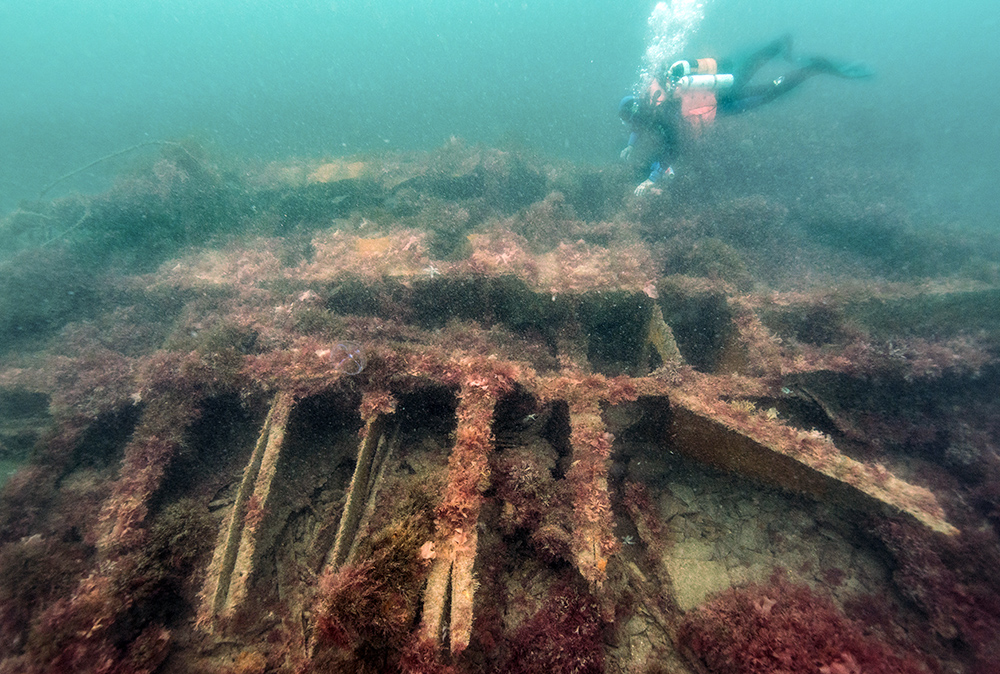

Image use policy
Our images can be used under a CC attribution non-commercial licence (unless stated otherwise).