Not Set
A retired paddle steamship that sank on her way to the shipbreaker’s yard.
Type
Passenger Paddle Steamship
History
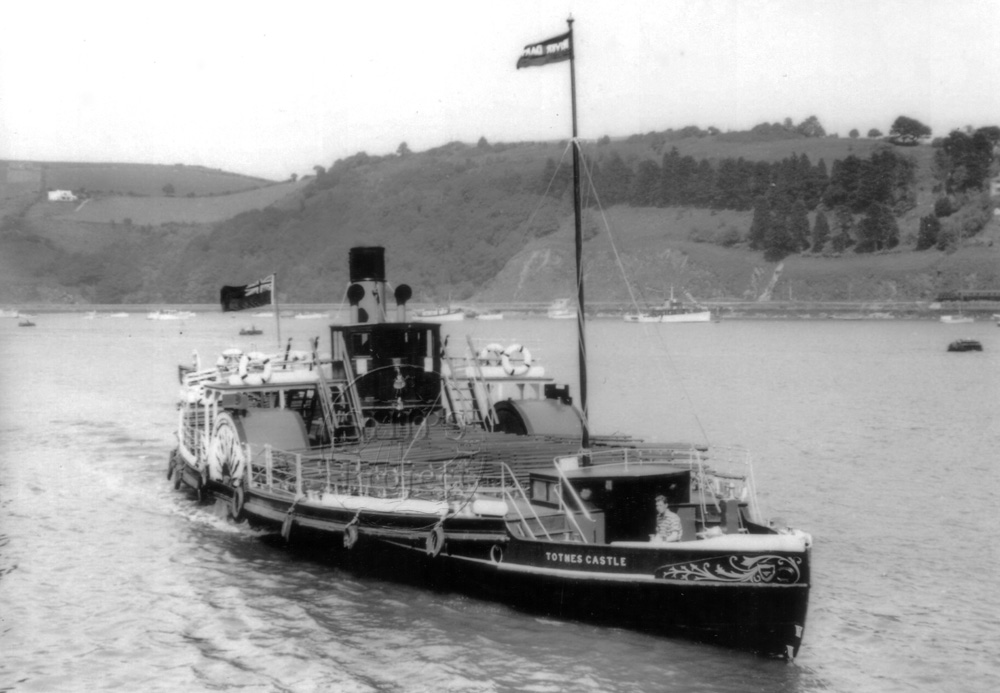
The paddle steamer Totnes Castle was built in 1923 by the shipbuilders Phillip & Son Ltd. of Dartmouth. She was the second vessel to bear the name; the previous Totnes Castle was launched in 1894, eventually becoming a houseboat. The 91-ton steel-built steamer was powered by a two-cylinder compound diagonal steam engine driving a centre-mounted paddle wheel on each side of a long and narrow hull. The Totnes Castle was operated by the River Dart Steamboat Company, running trips between Totnes and Dartmouth. She carried up to 400 passengers while drawing only 3ft of water, so she was an ideal vessel for the shallow waters of the River Dart.
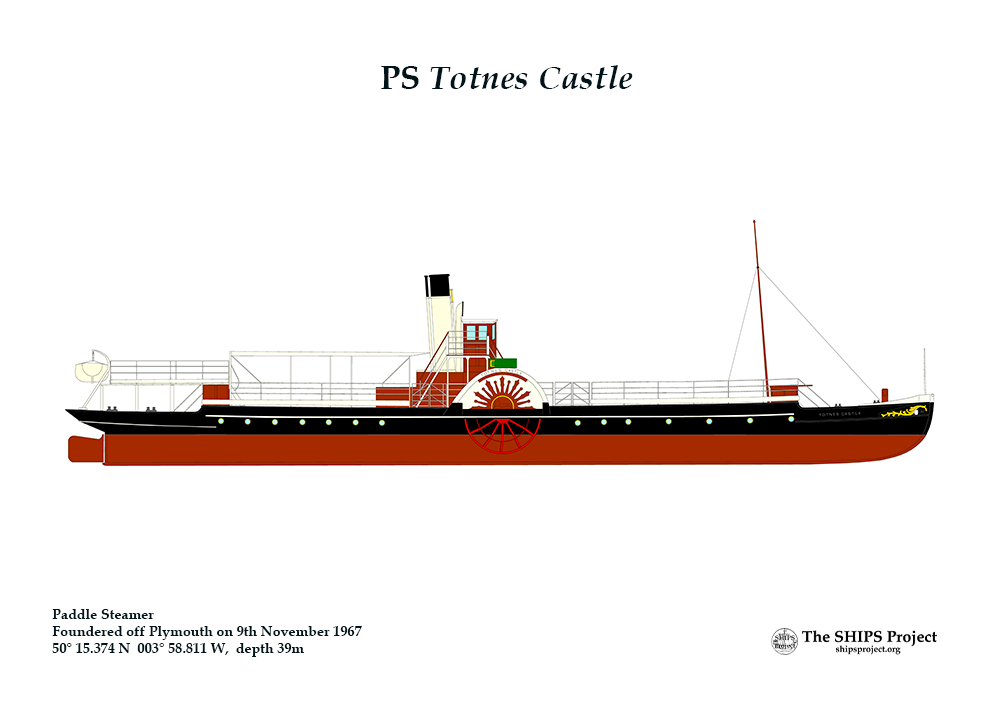
Drawing of the paddle steamship Totnes Castle, click the image for a larger version
In 1940, Totnes Castle was requisitioned by the Admiralty and used as a liberty boat in Devonport Dockyard, but just one year later, she was laid up. In 1941, the ship was again used to run pleasure cruises over the summer months, but after the war, the Totnes Castle resumed her trips up the Dart. By the 1960s, the ship was nearly 40 years old and needed an expensive major refit; instead, the River Dart Steamboat Company decided to replace her with a motor vessel.
In 1964, the Totnes Castle was converted to a 38-person accommodation vessel for a local sailing school; this venture was unsuccessful, and she was sold again that same year. She lay at her moorings on the Dart until 1967, when she was purchased by Ray Demelweek, who then patched her up to be towed away to be scrapped. On the 9th November 1967, the tug Antony took up the tow to take her to Demelweek and Redding’s scrapyard in Sutton Harbour, Plymouth. Halfway through the voyage, they ran into heavy seas off Burgh Island, the tug accidentally pulled the low-lying bow of the Totnes Castle into a heavy swell, and she started to fill with water. The crew of the tug had just enough time to retrieve their towing hawser before the Totnes Castle sank in 40m depth in Bigbury Bay, where she was abandoned. The bell of Totnes Castle was removed when she was replaced, and the bell can now be seen in the Totnes Museum.
Her sister ship, Kingswear Castle, was the last of a long line of paddle steamers to have been launched on the river Dart; she is Britain’s last coal-burning river paddle steamer. Built in 1924, she was bought in 1967 and restored to working condition. From 1985, she operated on the rivers Medway and Thames, and in 2012, the Kingswear Castle returned to the River Dart after an absence of 45 years. Kingswear Castle sails from Dartmouth and Totnes during the summer months.
The Totnes Castle remained lost until the Royal Navy hydrographic survey vessel HMS Gleaner relocated her in 1994. In June of that year, the divers Dicky Dorrington, Mike Pellat, Richard Endicott and Steve Worth went to investigate the anomaly picked up by Gleaner’s survey, and they found the paddle steamer lying upright on the seabed in 39m depth still with her portholes and other brass fixings intact.
This is a condensed version of the story. For more information, please contact The SHIPS Project.
Diving the Totnes Castle
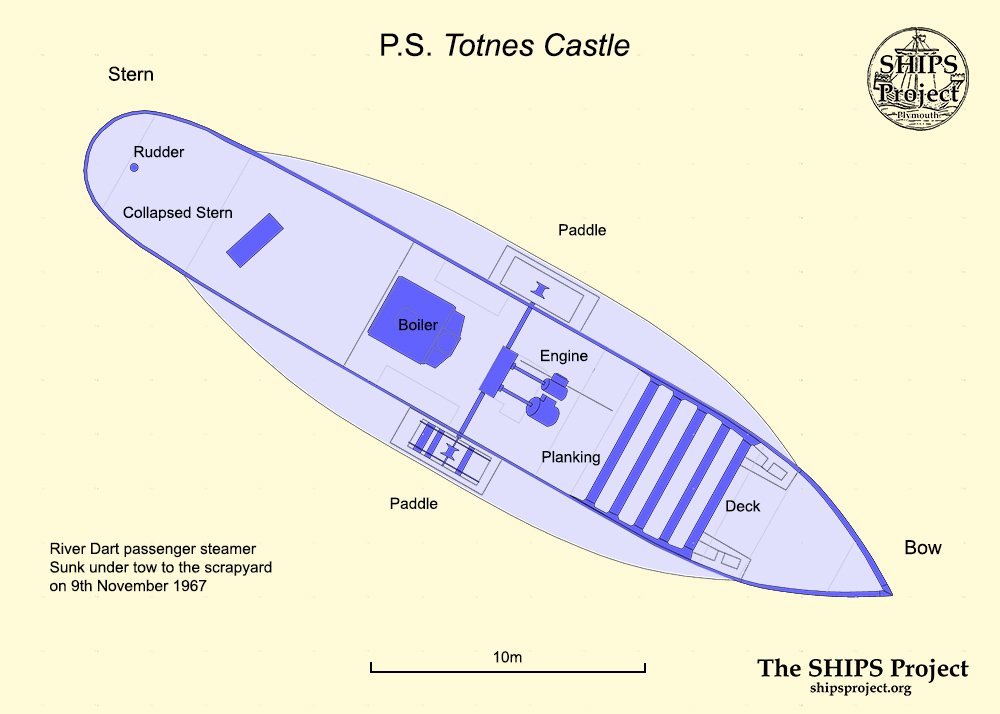
Site plan of PS Totnes Castle shipwreck by The SHIPS Project, click the image for a larger version
The remains of the paddle steamer Totnes Castle lie upright in a shallow scour pit with her bows to the south east, on a sand and gravel seabed at 39m depth. The 30m long steel hull is buried up to her waterline, but as a river boat with low freeboard, the sides stand just a few metres high in places. Much of the ship had been removed before she left the Dart, including the masts and wheelhouse, and the remainder has collapsed over the years.
The single boiler is the most prominent feature of the wreck, and the shot will normally lie just off this. Beginning the dive amidships, you can see the skeletal remains of the starboard paddle wheel; the port side one is completely gone. A section of hull beneath the forward passenger deck is still intact, and it is possible to swim through a narrow opening towards the bow. The bow itself is largely collapsed, save for the prow. The chain locker, replete with chain, can still be seen on the port side. Towards the stern, the wreck is almost at seabed level with most of the structure collapsed. Several conger eels inhabit the wreck and lobsters can be seen on the site.
Nearby wrecks include the steamship Persier  and Stoke Barge .
Last updated 06 March 2026



Information
Date Built:
1923
Type:
Passenger paddle steamship
Builder:
Phillip & Son Ltd., Dartmouth, Yard no. 612
Official Number:
130198
Length
33m (108.0ft)
Beam
5.4m (17.6ft)
Draft
1m (3ft)
Construction
Steel
Propulsion
Steam engine by Philip & Son, 2-cylinder compound diagonal (13, 25 x 24in), 120ihp, two paddles
Tonnage
91 GRT, 44 Net
Nationality
British
Crew
None
Master
None
Owners
River Dart Steamboat Company, while in service
Ray Demelweek, at time of loss
Portmarks
None
Date of Loss
9th November 1967
Voyage
Dartmouth to Plymouth
Manner of Loss
Foundered, sank under tow
Outcome
Abandoned.
Reference
NMR 1520837, UKHO 18418
Diving the Totnes Castle:
Underwater video of the Totnes Castle by diver Richard Knights in 2017
Not Set
Leave a message
Your email address will not be published.
Click the images for a larger version
![A diver by one of the paddle wheels on the wreck of the Totnes Castle [Joe Tidball]](../images/Wrecks/SHIPS_Wk_Totnes Castle4.jpg)
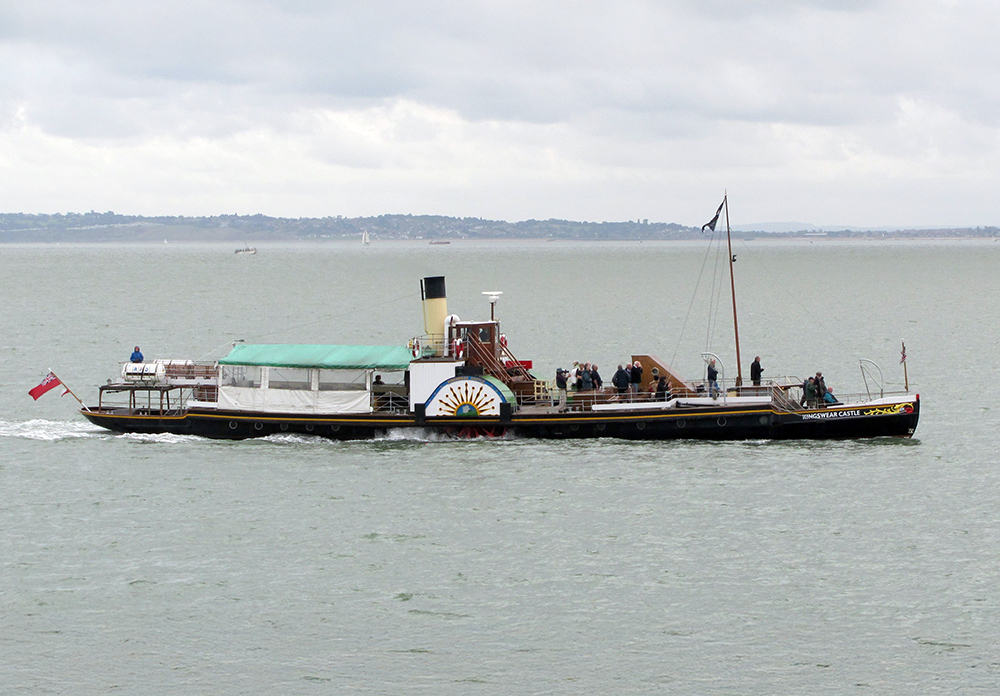
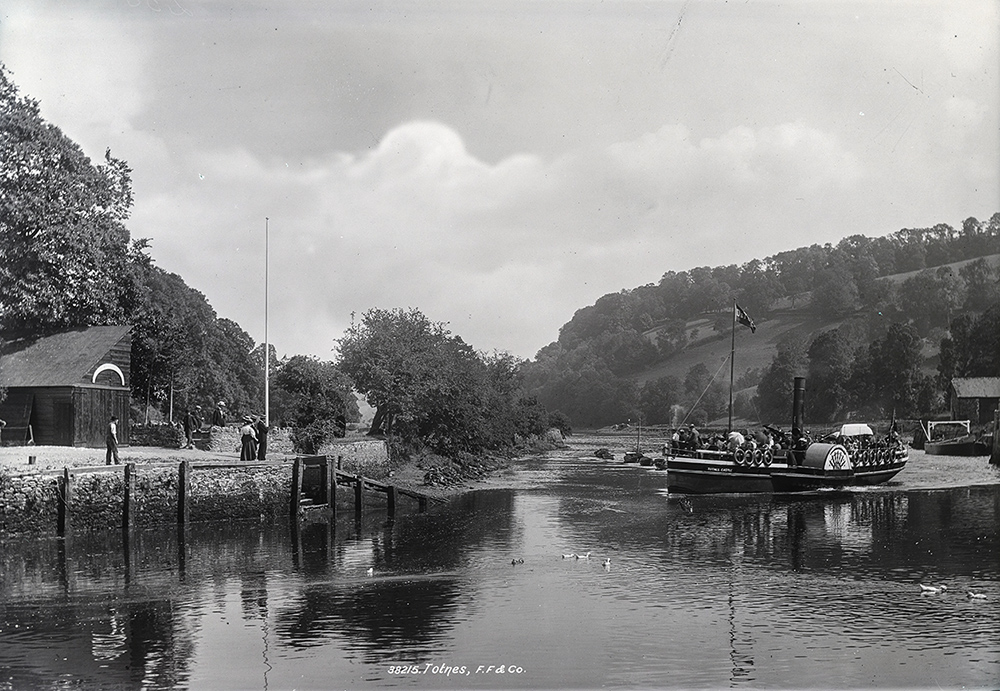
Image use policy
Our images can be used under a CC attribution non-commercial licence (unless stated otherwise).